

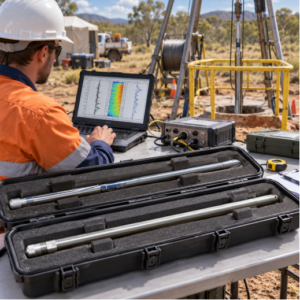
 Gamma ray borehole logging probes are widely used in coal, metal-mineral, and geological exploration because natural radioactivity can be measured passively and continuously with depth. The method is useful for lithologic correlation, identifying radioelement-rich intervals, and supporting stratigraphic interpretation in coal, metal-mineral, geological, mine-hydrogeology, and engineering programs.
Two related measurements are often confused. A total-gamma log counts radiation across a broad energy range and produces one curve. A spectral-gamma system sorts detected events by energy and estimates the contributions associated with potassium, uranium, and thorium. Both are valuable, but they answer different questions.
For available detector configurations, visit SAVIGEO and review its radioactive and nuclear borehole logging products. Gamma response is also sensitive to probe-to-wall distance, so borehole geometry should be considered during interpretation.
How a scintillation gamma probe works
Natural gamma rays enter a scintillation crystal and create small flashes of light. A photodetector converts those flashes into electrical pulses. Electronics count the pulses and, in a spectrometric tool, estimate their energies. The system then assigns each measurement to a depth from the wireline encoder.
Detector crystal type and volume influence sensitivity and energy resolution. Shielding, electronics, logging speed, sample interval, borehole geometry, casing, and distance from the formation also affect the recorded response. Count data have statistical variation, so moving too quickly or using an overly short counting interval can make the curve noisy.
The FD-3019 scintillation gamma logging tool is intended for total-gamma measurements. A natural gamma ray spectrometry logging tool adds energy-resolved acquisition for projects that need radioelement discrimination.
Total gamma: a robust correlation curve
Total gamma records the combined count rate from natural gamma-emitting constituents around the borehole. In many sedimentary settings, clay-rich layers have a higher response than clean sands or carbonates because clays can contain potassium and adsorb uranium or thorium. This familiar pattern is useful, but it is not universal. Potassium feldspar, mica, volcanic material, uranium mineralization, heavy minerals, and introduced materials can also raise the curve.
The method is attractive because it requires no active source and may often be run in open or cased holes. Casing, cement, fluid, and borehole diameter attenuate and modify the signal, so curves acquired under different conditions should not be compared as if the environment were identical. Total gamma is strongest as a repeatable marker and correlation tool when acquisition settings and borehole context are documented.
Spectral gamma: separating radioelement contributions
Gamma spectroscopy analyzes the energy distribution instead of collapsing all pulses into one total. Selected energy windows are used to estimate potassium, uranium, and thorium contributions. The U.S. Geological Survey describes spectral gamma logging as a means to characterize the relative occurrence of these natural radioelements and support lithologic and geochemical interpretation [1].
Spectral data can distinguish intervals that have similar total counts but different radioelement mixtures. That can help with clay typing, alteration studies, stratigraphic correlation, or recognition of uranium-enriched zones. The tradeoff is a greater need for counting statistics, energy calibration, stabilization, and careful quality control. A meaningful spectrum generally requires more counts than a simple total-gamma curve, which can influence logging speed.
The IAEA provides broader guidance on radioelement mapping and spectrometric calibration principles [2]. Instrument-specific procedures and project standards should determine the exact calibration and reporting method.
Choosing between total and spectral gamma
Choose total gamma when the main objective is depth correlation, broad lithologic contrast, shale indication, or a reliable passive reference curve. It is usually faster to acquire and simpler to interpret. Choose spectral gamma when the radioelement source matters and the expected geology can benefit from potassium, uranium, and thorium separation.
In practice, the decision depends on the target, expected count rate, required vertical resolution, borehole environment, and time available. A high-resolution spectrum collected too quickly may be less useful than a stable total-gamma log. Conversely, a strong total curve cannot reveal whether the increase is driven mainly by potassium or uranium.
For multi-parameter programs, gamma is often run with caliper, electrical, acoustic, or temperature measurements. Caliper provides essential geometry context; an enlarged borehole can increase the distance to the formation and reduce counts.
Field quality controls
ASTM D6274 describes practices for gamma logging, including planning, calibration, and documentation [3]. A practical checklist includes:
- Record tool model, detector type, serial number, energy settings, sample interval, and logging speed.
- Perform background and reference checks using the same configuration before and after the survey.
- Allow electronics and detector response to stabilize according to the operating procedure.
- Document casing, cement, fluid level, borehole diameter, and any diameter changes.
- Keep speed steady and slow enough for the required count statistics and vertical resolution.
- Acquire a repeat interval to test curve shape, amplitude stability, and depth alignment.
- Preserve raw counts or spectra as well as processed curves and calibration records.
Interpreting gamma logs without overclaiming
A gamma high is an observation, not a rock name. Begin by confirming that the feature is repeatable and not caused by a speed change, casing joint, diameter variation, or acquisition problem. Compare it with other logs and samples. Then describe the geological interpretations that fit the combined evidence.
For example, a high total-gamma interval with elevated potassium and thorium may support a clay-rich or felsic interpretation in an appropriate setting. A uranium-dominant anomaly requires different consideration. The interpretation should remain conditional until core, cuttings, mineralogy, or geochemistry support it.
Frequently asked questions
Is a gamma logging tool radioactive?
A natural-gamma probe is passive: it measures radiation already present in the formation and does not require a sealed source. Other nuclear logging methods may use a source, so equipment and procedures should never be generalized from the word “gamma” alone.
Can gamma be logged through steel casing?
Often yes, but steel and cement attenuate the response. Changes in casing thickness, multiple strings, cement, or borehole diameter can change curve amplitude. Record construction details and avoid comparing cased and open-hole amplitudes without correction or qualification.
Does high gamma always mean shale?
No. Shale is a common cause in many sedimentary basins, but radioactive minerals, feldspar-rich rock, volcanic material, phosphate, uranium enrichment, or completion materials can also produce high readings. Use spectral information and independent geology where available.
Conclusion
Total gamma provides a robust correlation curve; spectral gamma explains more about the source of natural radioactivity. The right detector, controlled counting conditions, borehole corrections, and multi-log interpretation determine how much value the data deliver. For tool selection, compare SAVIGEO’s radioactive and nuclear borehole logging products or discuss the target with the technical team.